
Need Help?
(07770) 26-11-82


Free standard shipping on all orders
You may return most new, unopened items within 30 days of delivery for a full refund. We'll also pay the return shipping costs if the return is a result of our error (you received an incorrect or defective item, etc.).
You should expect to receive your refund within four weeks of giving your package to the return shipper, however, in many cases you will receive a refund more quickly. This time period includes the transit time for us to receive your return from the shipper (5 to 10 business days), the time it takes us to process your return once we receive it (3 to 5 business days), and the time it takes your bank to process our refund request (5 to 10 business days).
If you need to return an item, simply login to your account, view the order using the "Complete Orders" link under the My Account menu and click the Return Item(s) button. We'll notify you via e-mail of your refund once we've received and processed the returned item.
Estimated delivery
24 to 72 Hours
We always aim for Next Day Delivery (**Excluding weekends)
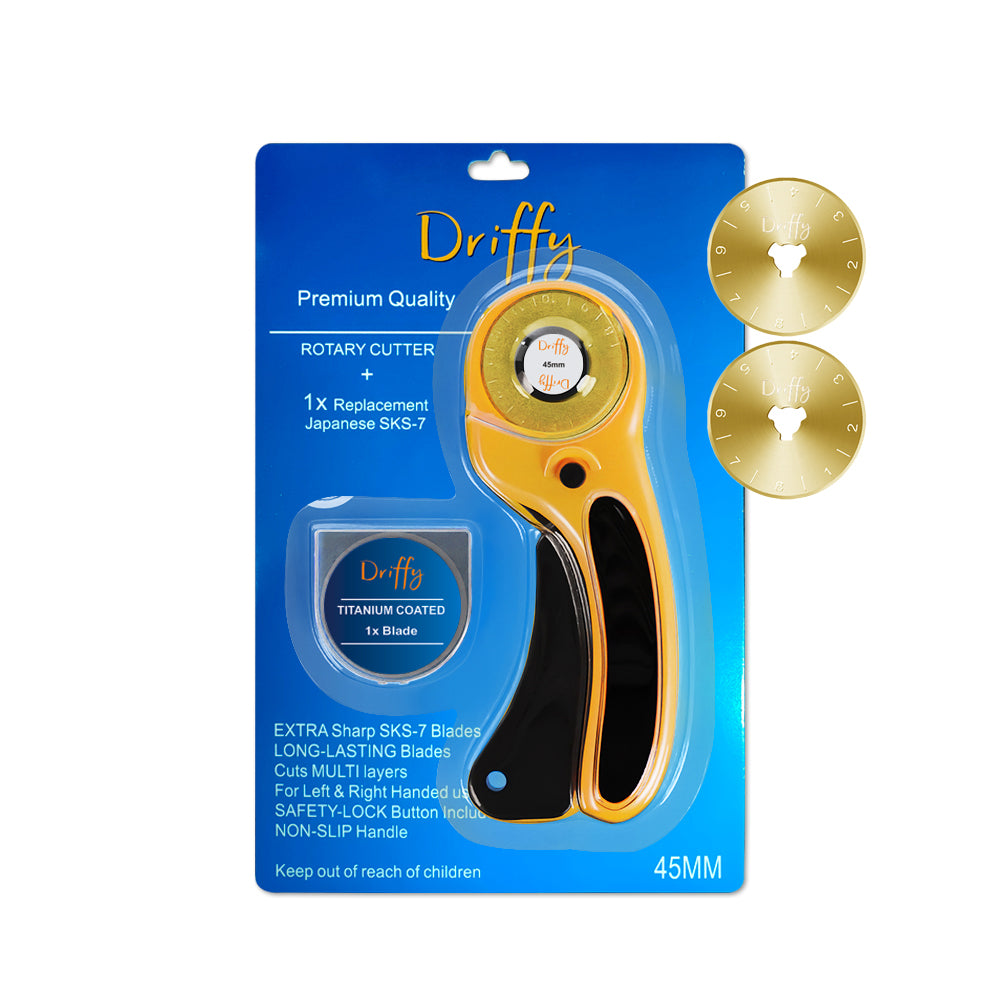
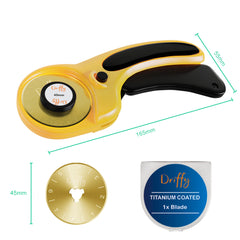
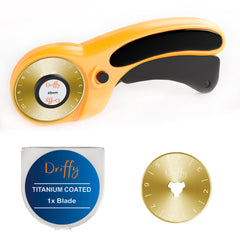
For every quilter, sewist, and crafter, the quest for the perfect cut is constant. You need clean lines, effortless precision, and a tool that doesn't leave your hand aching after a long session. Traditional scissors are slow, inaccurate, and can be a nightmare for anyone with grip-strength issues or arthritis. It's time to stop struggling and start creating with ease. The Driffy Rotary Cutter was engineered to solve these problems. Combining a state-of-the-art titanium-coated blade with a revolutionary ergonomic handle, this tool isn't just an accessory; it's a game-changing investment in your craft.
THE COMPLETE GUIDE TO
ROTARY CUTTERS
Everything Quilters, Patchworkers, and Crafters Need to Know
Whether you are a quilter cutting fat quarters for your next patchwork project, a garment maker slicing through pattern pieces, or a card crafter trimming precision shapes from cardboard, the rotary cutter is the single most important tool on your cutting mat. This comprehensive guide covers everything you need to know about choosing, using, maintaining, and getting the most from your rotary cutter — no matter your craft discipline or experience level.
A rotary cutter is a hand-held cutting tool that uses a circular blade to slice through fabric, paper, card, and other sheet materials. It works on the same principle as a pizza wheel: a sharp, freely spinning disc rolls along the material as you push or pull it, producing a continuous cut without lifting the blade. Unlike scissors, which compress and shear the material between two blades, a rotary cutter applies downward pressure through a single rotating edge. This makes it faster, more accurate, and far less tiring over long cutting sessions.
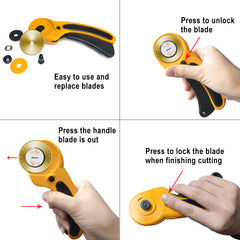
The tool consists of four basic components: a handle (which houses the grip and locking mechanism), a blade guard (which covers the blade when not in use), the circular blade itself, and a retaining nut or screw that holds the blade in place. Modern rotary cutters typically feature an ergonomic handle contoured to the palm, a spring-loaded or sliding blade guard for safety, and a quick-change mechanism that lets you swap blades without tools.
The rotary cutter transformed quilting when it was introduced to the craft market in the 1970s. Before rotary cutters, quilters had to trace templates onto fabric, then carefully cut around them with scissors — a process that was slow, physically demanding, and prone to inaccuracy. A rotary cutter paired with an acrylic ruler and self-healing cutting mat allows quilters to cut multiple layers of fabric simultaneously with ruler-guided precision. Strip quilting, which relies on cutting long, uniform strips of fabric that are then sewn together and cross-cut into blocks, became practical only because of the rotary cutter. Techniques like jelly roll quilting, log cabin blocks, and rail fence patterns all depend on the speed and accuracy that rotary cutting provides.
Rotary cutter blades come in four standard diameters, and choosing the right size is one of the most common questions new quilters and crafters ask. Each size has specific strengths, and many experienced crafters own at least two sizes for different tasks.
|
Blade Size |
Best For |
Limitations |
Typical Users |
|
18mm |
Very tight curves, miniature patchwork, detailed appliqué templates, paper crafting |
Too small for long straight cuts; dulls quickly on thick fabric |
Paper crafters, miniature quilters, model makers |
|
28mm |
Curved cuts, small patchwork pieces, appliqué, English paper piecing, intricate shapes |
Slower for long cuts; not ideal for cutting through many layers |
Quilters doing curved work, appliqué artists, garment cutters |
|
45mm |
General purpose quilting, straight cuts, strip cutting, cutting through 4–6 layers, most patchwork tasks |
Less manoeuvrability on tight curves than smaller blades |
Most quilters, patchworkers, garment sewers, general crafters |
|
60mm |
Cutting through many layers, thick fabrics (denim, batting, canvas), long straight cuts, bulk cutting |
Heavier, less precise on small cuts, requires more hand strength |
Professional quilters, upholstery workers, batch cutters |
The 45mm blade is the industry standard and the best starting point for anyone new to rotary cutting. It handles the vast majority of quilting and patchwork tasks comfortably. If you find yourself regularly struggling with tight curves, add a 28mm cutter to your toolkit. If you frequently cut through thick batting or multiple layers of heavy fabric, step up to a 60mm.
A rotary cutter should always be used on a self-healing cutting mat. The mat protects your work surface and, crucially, provides the slight give that keeps the blade sharp. Cutting on hard surfaces like glass, wood, or metal will dull your blade almost immediately. Position the mat on a stable, flat surface at a comfortable working height — ideally at waist height so you can apply even downward pressure without hunching over.
Place your acrylic ruler on the fabric with the ruler edge aligned to your cutting line. Press down firmly on the ruler with your non-cutting hand, keeping your fingers well away from the ruler edge. With your cutting hand, position the rotary cutter blade against the ruler edge and apply firm, even pressure. Cut away from your body in a single smooth motion, keeping the blade pressed against the ruler edge throughout the stroke. Never cut towards yourself, and never lift the blade mid-cut — this creates nicks in the cut line.
Hand fatigue and pain from rotary cutting is one of the most common complaints among quilters, especially during long cutting sessions. The key to comfortable cutting is grip: hold the cutter firmly but without squeezing tightly. Let the blade do the work. If you are pressing very hard, the blade is dull and needs replacing rather than compensating with force. Ergonomic rotary cutters with cushioned, contoured handles can make a significant difference, particularly for quilters with arthritis, carpal tunnel syndrome, or weak grip strength. Some cutters are designed specifically for left-handed use, though many modern models work equally well in either hand.
Cutting through multiple layers is one of the great advantages of a rotary cutter over scissors, but the layers can shift during cutting, leading to pieces of different sizes. To prevent this, press down firmly and evenly on the ruler, spreading your hand wide across it. Some quilters use small weights or pattern weights placed on the fabric beyond the ruler to hold the layers stable. Start your cut from the edge closest to you and maintain steady pressure throughout. If you are cutting more than four to six layers, switch to a 60mm blade for a cleaner result. Make sure the blade is sharp — a dull blade will drag and push the lower layers rather than cutting cleanly through them.
This is the single most common rotary cutter complaint, and in nearly every case the answer is the same: your blade is dull. A sharp rotary cutter blade should glide through quilting cotton with minimal pressure. If you find yourself pressing hard, going over the same line twice, or seeing uncut threads along the cut edge, it is time to change the blade. How often you need to replace blades depends on what and how much you are cutting, but as a general rule, a blade that has cut through approximately 20 metres of fabric is approaching the end of its useful life. Some heavy fabrics like denim, flannel, and minky will dull blades faster than lightweight quilting cotton.
Jagged edges and fraying are caused by a blade that is dull, nicked, or not spinning freely. First, check the blade for visible nicks or flat spots by carefully running your thumb along the edge (with extreme care). If you see or feel a nick, replace the blade immediately. If the blade appears intact, disassemble the cutter and check for lint, thread, or fabric debris caught around the axle. Clean everything with a dry cloth, apply a tiny drop of sewing machine oil to the axle, and reassemble. If the problem persists, the blade is dull and needs replacing.
A blade that does not spin freely will drag, skip, and produce uneven cuts. The most common cause is that the retaining nut has been tightened too much. Loosen it slightly — the blade should spin freely with a light flick of the finger, but should not wobble from side to side. If loosening the nut does not fix the problem, disassemble the cutter completely and remove any lint, thread, or dried adhesive from the axle and blade surfaces. Adhesive residue from fusible webbing or stabiliser is a frequent culprit.
When a rotary cutter leaves uncut threads along the cut line, the blade is either dull, improperly assembled, or not making full contact with the cutting mat. Check that the blade sits flat against the mat as you cut — if you are holding the cutter at too steep an angle, only part of the blade edge contacts the fabric. The cutter should be held at roughly 45 degrees to the mat surface. Also check that the blade is seated correctly on the axle and is not loose or misaligned.
Persistent hand pain from rotary cutting usually stems from gripping too tightly, using a dull blade (which forces you to press harder), or using a cutter with a handle that does not suit your hand size. Switching to an ergonomic rotary cutter with a cushioned grip can help enormously. Taking regular breaks, stretching your fingers and wrist between cuts, and ensuring your blade is always sharp are the three most effective ways to reduce hand strain. If you have arthritis or carpal tunnel syndrome, look for cutters with a pistol-grip or loop-handle design that distributes pressure more evenly across the palm.
There is no fixed schedule for blade replacement — it depends entirely on how much you cut, what materials you cut, and how you store the cutter. As a practical guide, replace the blade as soon as you notice any of the following: increased resistance when cutting, uncut threads along the edge, the need to go over a line more than once, or jagged/frayed edges on cut fabric. Many quilters find they replace blades every two to four weeks during active projects. Professional quilters and upholstery workers may go through blades weekly.
There are commercial blade sharpeners available that claim to restore rotary cutter blades, and some quilters use aluminium foil or fine-grit sandpaper as a DIY sharpening method. In practice, the improvement is marginal and short-lived. Rotary cutter blades are made from hardened steel ground to a precise bevel, and home sharpening cannot replicate that factory edge. For most quilters and crafters, the time spent sharpening a blade is better spent simply fitting a fresh one. Buying replacement blades in bulk packs of five or ten brings the per-blade cost down significantly and is far more practical than attempting to sharpen.
This is one of the most debated topics in quilting communities. Branded blades from manufacturers like Olfa and Fiskars are typically made from higher-grade steel and hold their edge longer, but they cost two to three times more than generic alternatives. Many quilters find that good-quality generic blades perform well for general quilting cotton and are perfectly adequate for everyday cutting. The key is to look for blades made from SKS-7 tungsten steel, which is the same alloy used in premium branded blades. Generic blades that use softer steel will dull noticeably faster, especially on heavier fabrics like flannel, batting, and denim. For most hobby quilters, buying quality generic blades in bulk represents the best balance of performance and value.
Absolutely. Blade replacement is the single highest ongoing cost of rotary cutting, and buying in bulk packs of five, ten, or more blades reduces the per-blade price substantially. A bulk pack of ten 45mm blades typically costs less than buying three individual blades at retail price. This is especially worthwhile for quilters who sew regularly, quilting guilds placing group orders, and small businesses like Etsy quilting shops that go through blades quickly. Keeping a stock of fresh blades on hand also means you are far less likely to continue cutting with a dull blade out of convenience, which protects both your fabric and your hands.
This is not an either-or question — most serious quilters and sewers use both. However, for different tasks, one tool clearly outperforms the other.
|
Factor |
Rotary Cutter |
Scissors |
|
Speed |
Much faster, especially for long cuts and strips |
Slower, requires more hand motions per cut |
|
Accuracy |
Ruler-guided precision; consistent results |
Depends on the user's skill and steadiness |
|
Multiple Layers |
Excellent; can cut 4–8 layers cleanly |
Struggles beyond 2–3 layers |
|
Curves |
Good with 18mm or 28mm blade; limited with larger blades |
Excellent for freehand curves and notches |
|
Hand Fatigue |
Lower fatigue over long sessions |
Higher fatigue, especially with thick fabric |
|
Ongoing Cost |
Blade replacements add up; bulk buying helps |
Lower; quality scissors last years with occasional sharpening |
|
Portability |
Requires a cutting mat |
Fully portable, no accessories needed |
For quilting and patchwork, the rotary cutter is the clear winner for the majority of tasks. Scissors remain essential for trimming threads, clipping curves on sewn seams, cutting around complex appliqué shapes freehand, and any cutting task where portability matters.
Although quilters are the primary market for rotary cutters, the tool is equally valuable in a range of other craft and professional disciplines.
Rotary cutters work well for cutting cardboard, mount board, and card stock, making them popular with model makers, architects building physical models, packaging designers creating prototypes, and paper crafters working with heavy card. For cardboard cutting, a standard 45mm blade will handle most card stock and thin corrugated board. For thicker corrugated cardboard, a 60mm blade provides more cutting leverage. Be aware that cardboard dulls blades faster than fabric, so use a dedicated blade for card cutting rather than switching between fabric and card on the same blade. Tungsten blades hold their edge longer on abrasive materials like cardboard.
Rotary cutters are widely used by leatherworkers, vinyl cutters, and upholstery professionals for cutting soft leather, faux leather, vinyl, and heavy upholstery fabrics. The rolling action of the blade produces a cleaner edge on these materials than scissors, which tend to stretch and distort them. Use a sharp 45mm or 60mm blade with firm, steady pressure. For genuine leather, a fresh blade is essential — leather dulls blades quickly, and a semi-sharp blade will drag and tear rather than cut cleanly.
Scrapbookers and paper crafters use small rotary cutters (18mm and 28mm) for precision cutting of decorative paper, vellum, and thin card. Specialty blades with wavy, pinking, or perforated edges are available for decorative cuts. These are also popular for making tear-away sewing patterns using skip-stitch blades that create a perforated line.
With dozens of rotary cutter models on the market, choosing the right one comes down to four factors: blade size, handle design, safety mechanism, and blade compatibility.
Start with a 45mm for general quilting and patchwork. Add a 28mm for curves and a 60mm for heavy-duty work as your needs grow.
Handles come in straight, contoured, and pistol-grip designs. Contoured handles with a soft-grip coating are the most comfortable for extended use. If you have arthritis or hand mobility issues, test several handle styles before committing. Some brands offer spring-assisted handles that reduce the force needed to cut.
Rotary cutter blades are extremely sharp and can cause serious injury. All quality cutters include a blade guard, but the mechanism varies: manual slide, automatic spring-retract, or squeeze-to-open. For workshop or classroom settings where multiple people are cutting, auto-retract models are strongly recommended. For solo use at home, the mechanism is largely a matter of personal preference.
One of the biggest practical considerations is blade compatibility. Not all brands of replacement blades fit all cutter handles, and this is important because blade replacement is an ongoing cost. The most widely compatible blade format is the standard Olfa-pattern 45mm blade, which fits Olfa, Fiskars, Clover, and many generic cutter handles. When choosing a cutter, check that affordable replacement blades are readily available for that model.
Rotary cutter blades are surgical-sharp and deserve the same respect as any cutting tool. Following basic safety practices will protect you, your family, and anyone working in a shared crafting space.
A self-healing cutting mat is not optional — it is essential. The mat protects your table, extends blade life, and provides the measured grid lines that make accurate cutting possible. Mats come in sizes from A5 to A0, but for quilting the most useful sizes are A2 (for general cutting) and A1 or larger (for cutting yardage and long strips). Choose a mat with clearly printed imperial and metric grid lines and 45-degree angle markings.
Transparent acrylic rulers are the partner tool to a rotary cutter. They provide the straight edge for the blade to run against while letting you see the fabric beneath. A 6-by-24-inch ruler is the most versatile single ruler for quilting. Square rulers in 6.5-inch, 9.5-inch, and 12.5-inch sizes are useful for squaring up quilt blocks. Look for rulers with non-slip dots or a grip coating on the underside to prevent shifting during cuts.
Beyond the standard straight-edge blade, rotary cutters can be fitted with specialty blades that create decorative effects. Wave blades produce a wavy edge ideal for decorative borders on quilted table runners and placemats. Pinking blades create a zigzag edge that helps prevent fraying on fabric that will not be hemmed. Skip-stitch or perforating blades cut a dashed line, useful for tear-away patterns and transferring designs. These speciality blades use the same handle as your standard blade, making them an inexpensive way to add creative options to your toolkit.
Rotary cutter blades are a consumable — they are designed to be used and replaced. Understanding your options and buying smartly can save significant money over time, especially if you quilt regularly.
Bulk blade packs of five, ten, or more blades offer the lowest per-blade cost and are the smartest purchase for anyone who quilts regularly. Solo quilters working on projects a few times a month will typically get through one or two blades a month. Quilting guilds can save substantially by placing group orders. Small Etsy sellers and quilting businesses that cut daily may go through a blade every few days and benefit enormously from bulk purchasing. Haberdashery retailers stocking replacement blades for their customers should look at wholesale packs of 50 or 100 blades at trade pricing.
What size rotary cutter blade do I need for patchwork? The 45mm blade is the standard for patchwork and general quilting. It handles straight cuts, strip cutting, and most quilting tasks. Use a 28mm for curves and small pieces, and a 60mm for cutting through many layers or thick fabric.
Can you use a rotary cutter on cardboard? Yes. A rotary cutter works well on card stock, mount board, and thin corrugated cardboard. Use a dedicated blade for cardboard cutting as it dulls blades faster than fabric. A 45mm or 60mm blade is best for card. Always use a self-healing cutting mat underneath.
How do I stop my rotary cutter from fraying fabric? Fraying during cutting is almost always caused by a dull or nicked blade. Replace the blade and ensure it spins freely on the axle. Cut with firm, even pressure in a single smooth stroke rather than sawing back and forth.
Are rotary cutters safe for beginners? Yes, with proper instruction and basic safety habits. Always use the blade guard, cut away from your body, and keep fingers clear of the ruler edge. Auto-retract models are a good choice for beginners as the blade covers itself after each cut.
What is the best rotary cutter for left-handed quilters? Many modern rotary cutters are designed to work in either hand. Look for models with a symmetrical handle and a blade guard that can be operated from either side. Olfa, Fiskars, and several generic brands offer ambidextrous models.
Is an electric rotary cutter better than manual for quilting? Electric rotary cutters reduce hand fatigue and are useful for quilters with limited hand strength or mobility issues. However, they are heavier, more expensive, less portable, and offer less tactile control than manual cutters. Most quilters prefer manual cutters for their simplicity and precision.
What is the difference between generic rotary cutter blades and branded ones? Premium branded blades typically use higher-grade steel and maintain their edge longer. However, quality generic blades made from SKS-7 tungsten steel can perform comparably at a fraction of the price. The key is the steel grade, not the brand name. Buying quality generic blades in bulk offers the best value for most quilters.
How do I prevent rust on my rotary cutter blade? Store your cutter with the blade guard closed in a dry environment. If you live in a humid area, wipe the blade with a light coat of sewing machine oil after each session. Never store a cutter on a damp cutting mat. Replace blades that show any rust spots, as corrosion creates rough patches that will snag and fray fabric.
The rotary cutter is a deceptively simple tool that has fundamentally changed how quilters, patchworkers, garment makers, and crafters approach cutting. Choosing the right blade size, maintaining a sharp edge, using proper technique, and investing in quality replacement blades are the foundations of efficient, accurate, and comfortable cutting. Whether you are making your first quilt, running a small quilting business, cutting cardboard prototypes in a design studio, or teaching a patchwork class of twenty students, the rotary cutter is the tool that makes precision cutting fast, repeatable, and — with good habits — entirely safe.
Keep your blades sharp, your mat clean, and your guard closed. Happy cutting.
The heart of any cutter is its blade, and this is where the Driffy model truly excels. Forget blades that dull quickly or snag on tough materials.
Our blades are forged from high-strength, SKS-7 tungsten steel and then coated with a layer of titanium. This combination provides two key advantages:
This powerful blade makes the Driffy Rotary Cutter the perfect tool for a huge range of materials. Effortlessly cut through:
One of the biggest challenges for passionate crafters is physical discomfort. We designed our rotary cutter with this specifically in mind.
Our unique ergonomic handle is designed to fit comfortably in your hand, minimising the grip strength and pressure needed to make a cut. This makes cutting fabric a "doddle," no matter how thick it is. This focus on comfort makes the Driffy Rotary Cutter the best rotary cutter for users with arthritis or limited hand strength.
Don't just take our word for it:
"I'm happy that my arthritis isn't acting up so much when I'm using the Driffy Rotary Cutter." - Nancy Hagan, Colorado
A sharp tool needs to be a safe tool. The Driffy Rotary Cutter includes standout safety features to protect you and your family.
The cutter features a Secure Trigger mechanism. The blade is only exposed when you squeeze the handle to cut. The moment you let go, the blade retracts safely into its housing. This simple, intuitive system prevents accidental slips and cuts.
Furthermore, the tool is designed for everyone. Whether you are left-handed or right-handed, the handle and trigger are perfectly designed for comfortable and safe use without struggle.
We know our product will become an essential part of your sewing and crafting kit. That's why we back it with an unbeatable guarantee and provide everything you need to get started.
We include an extra blade just in case, ensuring you can keep crafting without interruption.
We want you to love your new tool, which is why we offer a no-questions-asked 30-day return policy. In addition to this, the handle is covered by a comprehensive one-year warranty. With 100% customer satisfaction as our goal, you have nothing to lose! It's time to cut without effort and bring a new level of professionalism and enjoyment to your craft.
Get the latest updates on new products and upcoming sales
Thanks for subscribing!
This email has been registered!
| Product | SKU | Description | Collection | Availability | Product Type | Other Details |
|---|